Training load
Training load, and the ratio everyone quotes.
Training load is the running total of what you have asked your body to do, and how fast you asked. Read well, it is the earliest warning you get that a good month is turning into an injury. Read badly, it is one number used as a rule.
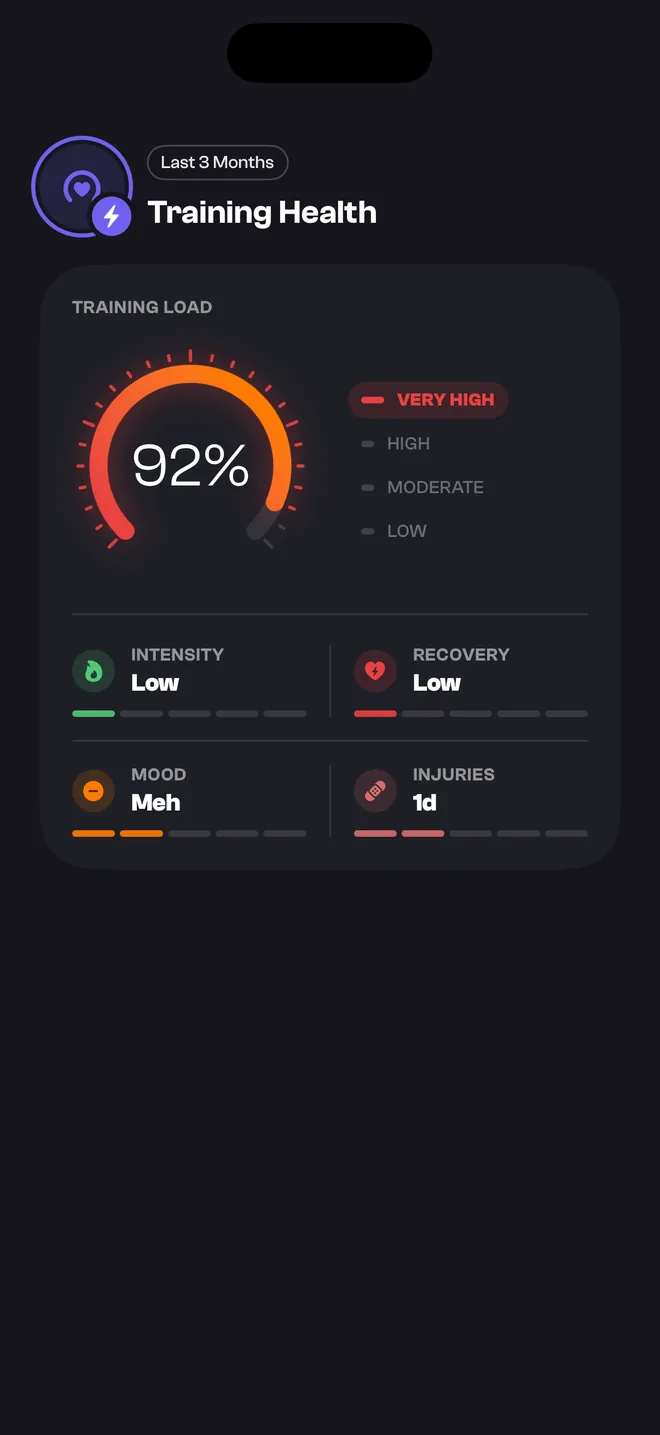
What training load measures
Training load is volume and intensity together. Ten easy kilometres and ten hard ones cost very different amounts, so distance alone under-reports a fast week and over-reports a slow one. Any load model worth the name weights the work by how hard it was.
The reason to track it is that the damage from doing too much rarely shows up on the day. It accumulates. A single big long run is almost never the problem; four weeks of quietly climbing volume, with the hard days creeping closer together, usually is. Which is also why it has to be built from every run you record, indoors and out, rather than the ones that happened to be logged in the right app.
Acute vs chronic, and the ratio
The standard framing splits load in two. Acute load is what you have done recently — conventionally the last seven days. Chronic load is what you have been doing consistently — conventionally the last twenty-eight. Chronic load is your fitness, in the sense that matters here: the amount of work your body has come to expect.
The acute:chronic workload ratio, or ACWR, is simply the first divided by the second. At 1.0 this week looks like your recent normal. At 1.4 it is forty per cent heavier than what you have prepared for. The widely quoted guidance puts the comfortable range at roughly 0.8 to 1.3, with risk rising above about 1.5.
Where the ratio misleads
It is worth knowing the limits of a number before you obey it. Three matter for runners:
- The denominator can be gamed. A deliberately quiet month lowers your chronic load, so a perfectly ordinary week afterwards reads as a spike.
- The research is contested. The original studies have been challenged on their statistics, and the thresholds are better treated as rules of thumb than as findings.
- It cannot see the rest of your life. Sleep, illness, work and stress all change what a given load costs, and none of them are in the ratio.
None of that makes it useless. It makes it one input. A ratio that has climbed for three weeks running is worth a look; a single week at 1.4 during a build is usually just a build.
The parts of load that get missed
Two runners can carry the same weekly load and be in completely different places, because load has a shape as well as a size. TrakRun reads that shape as well as the total:
- Ramp rate — how quickly the volume is climbing, rather than where it currently sits.
- Monotony — whether every run is the same run. A week with no easy days and no hard ones is more taxing than its total suggests.
- Hard–easy sequencing — whether the hard sessions have anything soft between them, and whether the easy days are actually easy.
- Long-run share — how much of the week sits in one session.
The last one is the most commonly self-inflicted: easy runs drifting up in pace until the whole week is moderate. It shows up as a flat, unvarying load long before it shows up as an injury, and it is the sort of thing you can only see against your own history.
How TrakRun shows it
Training Health puts load on one dial with the things that change what it costs — intensity, recovery, sleep, and any injury you have logged — on the same page, over a rolling 90-day window by default. Your Coach reads them together and makes one call for the day: push, adapt or recover, with the reasoning attached rather than a verdict on its own. Garmin, Strava and TrainingPeaks all chart training load; the point here is a single call for today that shows the load, recovery and sleep behind it.
Load is only half the question, though. It tells you what the last month asked of you; your readiness score tells you what today has got. Where the two disagree, the disagreement is the useful part.
Training-load analysis is part of TrakRun Pro. It is calculated from the runs already in Apple Health, so there is nothing to import and no history to rebuild.
Common questions
- What does ACWR stand for?
- Acute:chronic workload ratio — your recent training (typically the last 7 days) divided by what you have been doing over a longer window (typically the last 28). Above 1 means this week is heavier than your recent normal; below 1 means it is lighter.
- What is a safe ACWR for a runner?
- The figure usually quoted is roughly 0.8 to 1.3, with risk said to rise sharply above about 1.5. Treat it as a rough guide rather than a limit: the original research has been challenged on its methods, and the ratio is easy to game — a deliberately light month lowers the denominator and makes an ordinary week look reckless.
- Is training load the same as a readiness score?
- No, and they answer different questions. Training load describes the shape of your last few weeks; a readiness score describes today. They regularly disagree — a good readiness score in the middle of a sharply climbing month is still a reason to be careful — which is why TrakRun shows both rather than blending them into one number.
- How does TrakRun calculate my training load?
- From the runs already in Apple Health, over a rolling 90-day window by default, whichever app recorded them. There is nothing to enter by hand: if a run reached Apple Health it counts towards your load, including sessions recorded in Strava, Runna or WHOOP.