Readiness
What a readiness score actually tells you.
A readiness score answers one question before you train: how much has your body got today? TrakRun builds one each morning from your recovery, your recent sessions and your own baseline — and shows every point that went into it, so you can disagree with it.
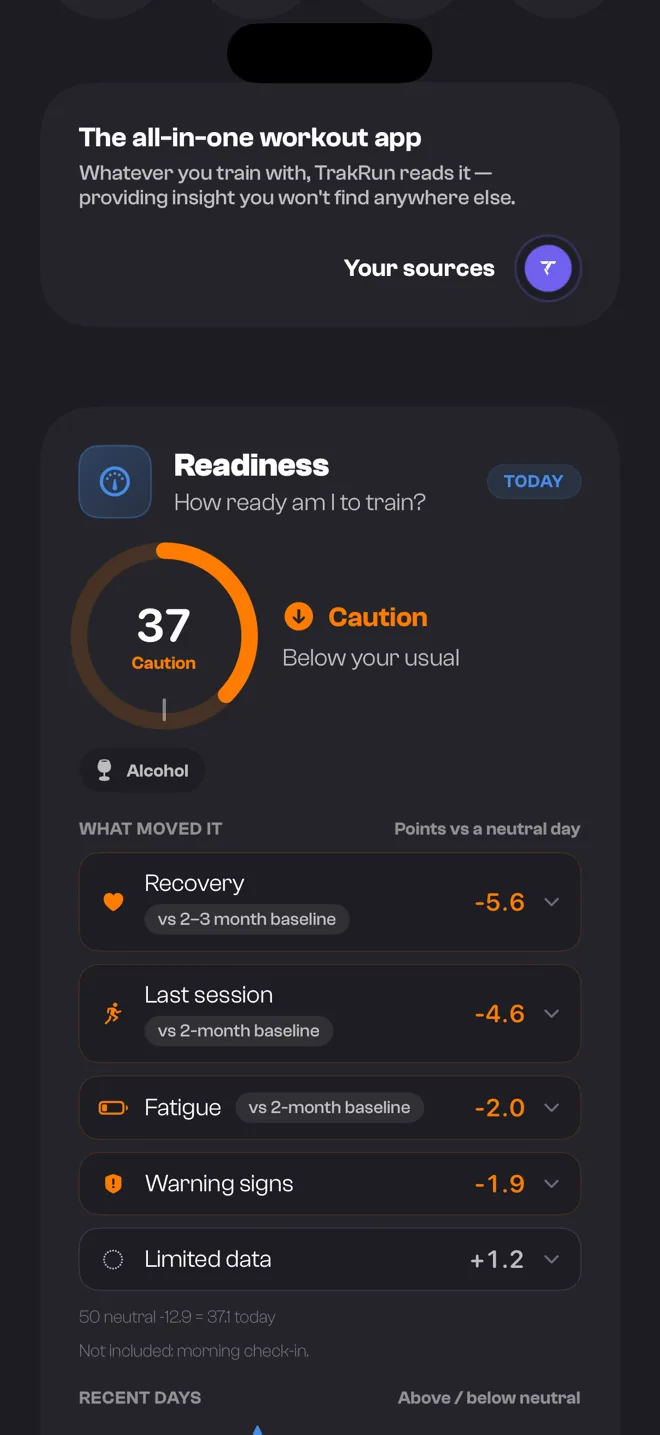
What a readiness score is
A readiness score is a single daily number that estimates how prepared your body is for hard work. It is built from signals you produce overnight and in the days before — heart rate variability, resting heart rate, sleep, and the training you have already done — and it exists to make one decision easier: push today, or hold back.
The important word is relative. Heart rate variability differs enormously between people, so an absolute reading tells you very little on its own. What tells you something is your reading against your own recent normal. Every readiness score worth having is a comparison with your own history, and one that isn’t is just a number with a colour on it.
For how to measure HRV well, smooth out noisy nights and weigh it against resting heart rate, read HRV versus resting heart rate.
How TrakRun scores your day
TrakRun starts every day at a neutral 50 and moves it. Each contributing factor is worth a number of points, plus or minus, and the score is what they add up to. That is why the card shows an equation rather than a verdict: the points have to reconcile to the number, so nothing can be asserted that isn’t accounted for.
The factors it reads:
- Recovery — your overnight cardiovascular signals against your own baseline.
- Recent training — where you stand relative to the session that defines your day, counted in nights slept since.
- Fatigue — accumulated cost that hasn’t been paid back yet.
- Adaptation — the part of that cost that has turned into fitness.
- How you feel — your own logged mood and wellness, which the score is not allowed to overrule silently.
- Safeguards — a logged injury or illness, which outranks everything above it.
There is one more row, and it is honest about itself: when the model is less certain of a reading, it pulls the score back toward your typical day rather than acting confident. That adjustment is shown as its own line rather than folded into the others.
Reading the bands
A raw number needs a boundary to mean anything, and TrakRun’s boundaries are yours. Once you have roughly 90 days of history, the bands are set at your own score percentiles — so the top band is rare by construction, and a middling day is described as one rather than dressed up.
The bands run from peak through ready, the moderate range, caution and low, to recover. The middle is deliberately subdivided: a single band holding nearly half your days can’t move you, because a caption you see every other morning stops carrying information.
What to do with a score
A score on its own is trivia. What makes it useful is the sentence attached to it, and TrakRun writes that sentence from the same data — one clause of reasoning, then it stops. A high score suggests today is the day for the hard session. A low one usually means shorter or easier, not nothing at all.
Readiness also isn’t the whole picture. It describes today; your training load describes the shape of the last month, and the two disagree often enough to be worth reading together. A good score in the middle of a sharply climbing month is still a reason to be careful.
And it is a suggestion, never a rule. You know things the data doesn’t — a stressful week, a bad meal, a race you have decided to run anyway. TrakRun shows its working precisely so you can look at the rows, decide it has weighted something wrongly, and go and run.
Race week is where reading it well matters most. The piece on London Marathon recovery walks through the taper, what a suppressed HRV means before a race, and when to run again after one.
Where the numbers come from
Everything above is read from Apple Health, with your permission — so an Apple Watch worn overnight is enough, and nothing needs to be typed in. Runs recorded in other apps count too, because they arrive through Apple Health as well.
Readiness is free, alongside recording, route maps, splits, history, and mood and injury logging. TrakRun Pro adds Your Coach, which turns the score into a call on today’s session.
Common questions
- What is a good readiness score?
- There isn't a universal one. A readiness score is a comparison, so the number only means something next to your own recent scores — 62 can be a strong day for one runner and a flat one for another. TrakRun sets its bands from your own score history once it has around 90 days of it, so a high band stays genuinely rare rather than something half your days qualify for.
- Do I need a chest strap or a WHOOP band for a readiness score?
- No. TrakRun reads what your Apple Watch already records overnight through Apple Health — heart rate variability, resting heart rate and sleep. If you do wear a WHOOP or a chest strap and it writes to Apple Health, those readings feed in the same way.
- Why is my readiness low after a good night's sleep?
- Sleep is one signal among several. A hard session two days ago, a week of climbing load, or a logged injury can all pull a score down while your sleep looks fine. That is why every factor is itemised: the score is the sum, and the rows tell you which part of it you are actually being asked to act on.
- Should I skip a run when readiness is low?
- Not automatically. A low score is a reason to change the session rather than to cancel the day — usually shorter, easier, or both. TrakRun says which, in one line, rather than leaving you to interpret a number. The exception is an injury you have logged, where it will hold you back until you clear yourself to train.