HRV
Heart rate variability versus resting heart rate: which should guide your recovery?
Your watch says your HRV dropped overnight, but your resting heart rate looks normal and your legs feel fine. Do you run the intervals or not? Both numbers measure recovery, but they answer slightly different questions, and knowing which to trust on which morning is most of the skill.
Heart rate variability has become the headline recovery metric on almost every wearable. Resting heart rate is older, simpler and still useful. Runners are often told to follow one or the other, when in practice each covers the other’s weaknesses.
This guide explains what HRV is, how to measure it reliably on an Apple Watch or WHOOP, how to smooth out noisy readings, and how to combine HRV with resting heart rate, sleep, mood and training load to decide what to run today.
What heart rate variability is, and why it matters for runners
HRV measures the gaps between heartbeats
A healthy heart does not beat like a metronome. At 60 beats per minute, the gap between beats might be 0.95 seconds, then 1.05, then 0.98. Heart rate variability is a measure of how much those gaps vary, in milliseconds.
The variation comes largely from the parasympathetic nervous system, the “rest and digest” side, which slows and adjusts the heart beat by beat. When you are well recovered, it has more influence and HRV tends to be higher. Hard training, poor sleep, illness, alcohol and stress all shift the balance, and HRV tends to fall.
Resting heart rate measures how hard the heart works at rest
Resting heart rate is simply your lowest steady heart rate, usually taken overnight or on waking. It falls as aerobic fitness improves, and it rises by a few beats when your body is dealing with extra stress: accumulated training, dehydration, heat or an infection coming on.
Why runners should care
Most running improvement comes from recovering well between sessions, not from the sessions themselves. The hard part is that fatigue is hard to feel accurately. Legs can feel fine while the rest of the system is still behind, and a planned session can arrive on exactly the wrong day.
HRV gives you an outside view. In a study of 40 recreational runners, Vesterinen and colleagues (2016) only scheduled hard sessions when a runner’s morning HRV was inside their own normal range. That group did fewer hard sessions than a group on a fixed plan, yet improved their 3,000 m time by 2.1%, while the fixed-plan group’s change was not significant.
The wider evidence is more modest. A 2021 meta-analysis of HRV-guided endurance training found a small, non-significant effect on performance, with fewer runners failing to respond. HRV will not make you fast. It helps you avoid wasting hard days.
HRV versus resting heart rate: which should guide your recovery?
The honest answer is both, with different jobs. In a 2014 review of heart rate monitoring, changes in HRV tracked changes in 10 km performance only slightly better than changes in heart rate did (r = 0.76 against 0.73). HRV readings also swing far more from day to day.
| HRV | Resting heart rate | |
|---|---|---|
| What it reflects | How much the nervous system is in rest-and-recover mode | How hard the heart is working at rest |
| How fast it reacts | Often the next night after hard training, alcohol or stress | Usually a little later, and by a few beats |
| Day-to-day noise | High, so single readings mislead | Lower, so it is easier to read |
| Comparable across devices | No: SDNN and RMSSD give different numbers | Roughly, in beats per minute |
| Best used as | The early warning, read as a trend | The confirmation |
So treat HRV as the early warning and resting heart rate as the confirmation. HRV dropping on its own is worth watching. HRV below your range for several days while resting heart rate is also up is worth acting on. Two signals agreeing beat one signal shouting.
How to measure HRV reliably with Apple Watch and WHOOP
Apple Watch
Apple Watch takes short HRV readings in the background, including while you sleep, and writes them to Apple Health as SDNN, the standard deviation of the gaps between beats. You will find them under Browse, Heart, Heart Rate Variability. Resting heart rate, sleep and respiratory rate are recorded alongside.
On recent watchOS versions, the Vitals app builds a typical range for your overnight metrics and notifies you when several fall outside it at once. That is the right idea: it compares you with yourself.
To get useful readings, wear the watch to bed on most nights, keep it snug enough for the optical sensor, and keep it charged. A missing night is better than a bad one, but a baseline built from three nights a week takes much longer to settle.
WHOOP
WHOOP calculates HRV as RMSSD during sleep and uses it in its Recovery score. Unlike Apple Health’s SDNN, RMSSD reflects beat-to-beat changes, so the two give different numbers for the same heart.
One practical catch: WHOOP does not write HRV to Apple Health. It writes sleep, resting heart rate and respiratory rate, but its HRV stays in the WHOOP app. Any app that reads Apple Health, TrakRun included, sees WHOOP’s resting heart rate but not its HRV.
The best time to measure
Most research on HRV-guided training uses a short reading taken straight after waking. A 2021 review of the methods found that 87.5% of studies measured in the morning, and that results from overnight readings were less consistent.
Newer evidence is kinder to overnight readings. In a 2024 study of recreational runners, overnight HRV responded to a block of intensified training, and those responses were linked to changes in performance. Morning readings did not respond in the same way, so the two methods are not interchangeable.
Wearables measure overnight because it needs no effort, and that works well if you stay consistent. The rule is the same state, at the same time, on the same device. If you take manual readings with a chest strap, do it straight after waking, after the toilet and before coffee, in the same position every day.
Don’t compare devices, or people
An SDNN of 45 ms on an Apple Watch and an RMSSD of 70 ms on a WHOOP might describe the same night. Numbers from different devices, or different people, are not comparable. If you switch devices, expect to rebuild your baseline from scratch.
Smoothing noisy readings so you act on trends
Use a 7-day rolling average
Single HRV readings jump around. A late meal, one drink or a warm bedroom can move tonight’s number a long way with no lasting meaning. That is why the sports science literature recommends a 7-day rolling average rather than daily values, and why most studies use a 3-to-7-day window.
Compare it with your own normal range
Your baseline is your average over a longer window. Studies differ on how long, from a rolling ten days to a fixed block of weeks, and TrakRun uses two to three months. A common way to set a normal range, used in several training studies, is your baseline plus or minus half a standard deviation. Readings inside it mean nothing has changed. Readings below it for several days are the signal.
A worked example
Take an illustrative runner whose two-month average SDNN is 50 ms, with a standard deviation of 6 ms. Their normal range is 47 to 53 ms.
- A normal week: 52, 48, 55, 50, 46, 53 and 49 ms average 50.4 ms. Two nights dipped below 47, but the trend is squarely in range.
- One bad night: swap the 52 for a 38 after a late party and the average only falls to 48.4 ms. Still in range, so no change to training.
- A real dip: three nights of 40, 41 and 39 bring the average to 45.4 ms, below range. If resting heart rate has crept up too, this is the week to back off.
Common HRV pitfalls
- Reacting to one night. It is the most common mistake and the reason rolling averages exist.
- Chasing a higher number. HRV is a readout, not a target. Your absolute value says little about your fitness or your running potential.
- Ignoring the obvious causes. Alcohol, late heavy meals, heat, travel and illness all drop HRV. Note them, so a low night has an explanation.
- Assuming the number always tells the truth. In very fit runners with a low resting heart rate, HRV can stop tracking recovery cleanly, a pattern researchers call parasympathetic saturation. If HRV looks fine but you feel wrecked, trust the fatigue.
- Switching devices or wrists mid-baseline. Different sensors and methods mean a new baseline.
- Letting it overrule how you feel. A normal HRV does not cancel a sore calf or a fever.
Combining HRV with sleep, mood and training load
HRV is one input. A good daily decision reads it alongside four others: resting heart rate, last night’s sleep, how you feel, and how much training you have done recently. A rising training load, particularly a week well above your recent normal, is a reason to be careful even when your recovery readings look fine.
These rules of thumb cover most mornings:
| What you see | What to do today |
|---|---|
| HRV in range, resting HR normal, slept well, feel good | Train as planned. A good day for the hard session. |
| HRV low for one night, everything else normal | Train as planned. One night is usually noise. |
| HRV in range, but slept badly or feel flat | Run, but keep it easy or shorten the hard part. |
| 7-day HRV below range and resting HR up for two or three mornings | Easy running or rest until both come back. |
| Any of the above plus a sore throat, fever or niggle | Rest, and see someone qualified if it persists. |
Notice that a low reading changes the session rather than cancelling the day. The research above found the benefit came from moving hard sessions to better days, not from training less overall. Easy running on a low day is still training. It is just the right training.
If you train by heart rate, low-recovery days also push your easy-run heart rate up. The article on HR zones versus pace zones explains why that happens and what to do about it.
How TrakRun turns HRV trends into one push-or-recover call
Reading five signals and a rolling average every morning is exactly the kind of job that goes wrong in your head at 6am. TrakRun does it for you, and shows its working.
Where the data comes from
- Apple Watch overnight readings of HRV, resting heart rate and sleep, read through Apple Health with your permission.
- WHOOP resting heart rate and sleep, which WHOOP writes to Apple Health. Its HRV isn’t available there, so TrakRun doesn’t see it.
- Runs from Strava, Runna, WHOOP and Apple’s Workout app, which reach Apple Health and count towards your training load.
- Runs recorded in TrakRun on your iPhone or Apple Watch, and the mood and injury check-ins you log.
The readiness score
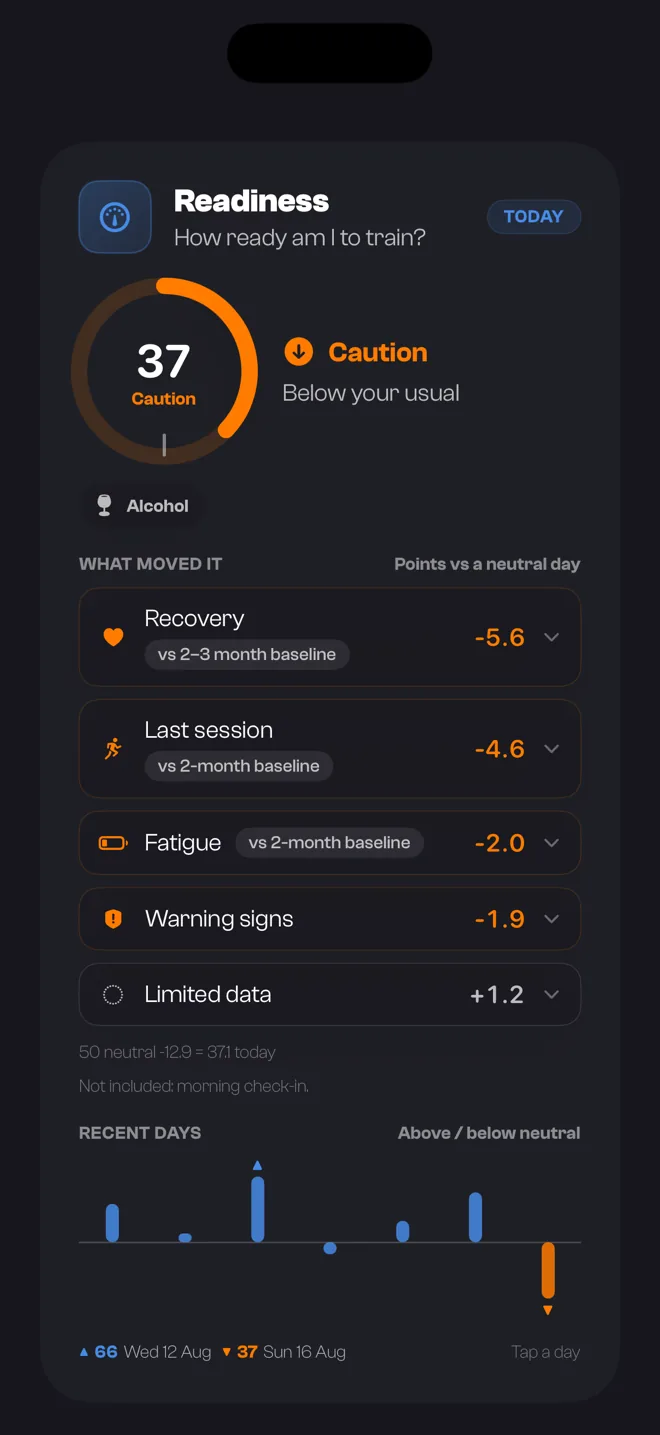
Each morning TrakRun builds a readiness score. It starts at a neutral 50 and adds or subtracts points for each factor. Your overnight recovery signals are scored against your own two-to-three-month baseline, not against other people.
Every factor is itemised, so you can see whether a low score is about recovery, a hard session two days ago or accumulated fatigue. When data is thin, the score says so and pulls back toward your typical day rather than acting confident.
Your Coach
Your Coach turns readiness, training load and your recent sessions into one call: push, adapt or recover, with the session to do. The call itself is made by fixed rules applied to your data. A language model writes the headline and summary around it, but never sees your raw workouts and cannot change the call.
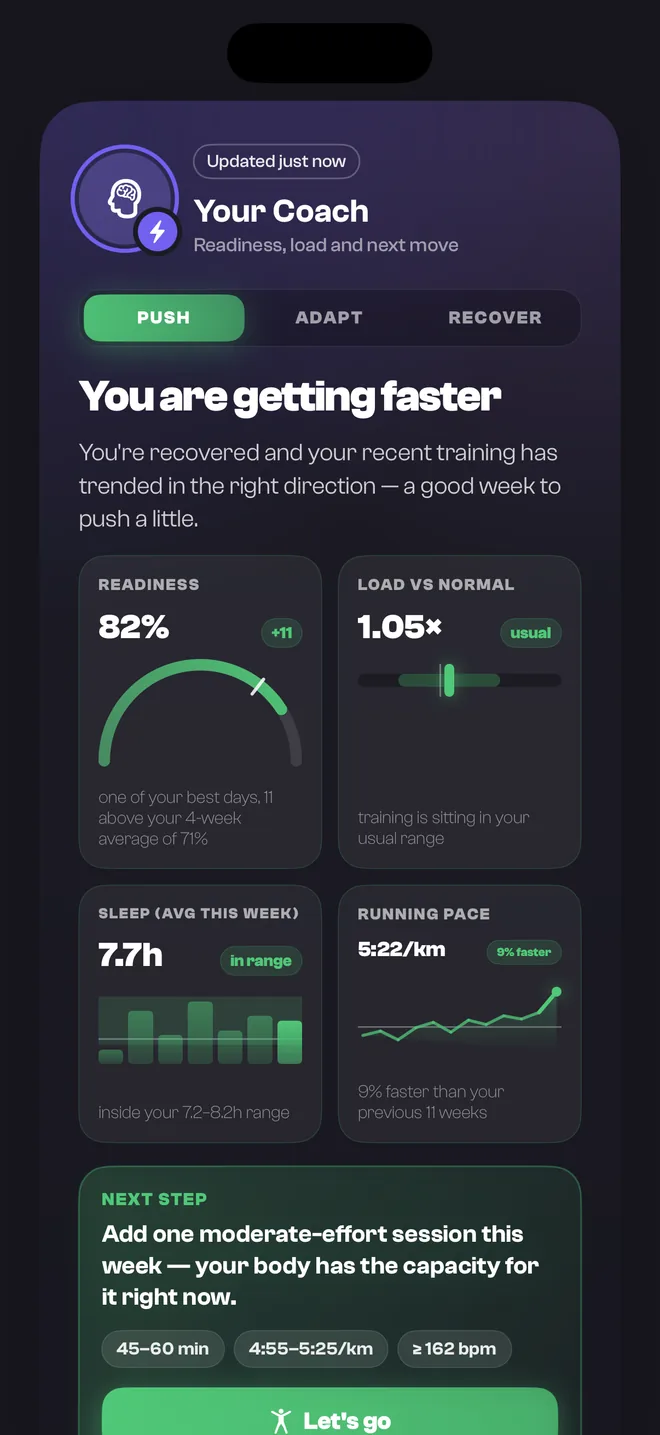
It follows the same logic as this article. A merely below-average morning is not enough to change your day: it needs something to agree with it, such as your score clearly down on your four-week average, another recovery reading pointing the same way, or a climbing load. A very low reading, a logged injury or high fatigue means recover.
And it is a suggestion, never a rule. You know things the data doesn’t, and the itemised rows are there so you can disagree with them.
HRV or resting heart rate: the short answer
HRV is the more sensitive recovery signal, and resting heart rate is the steadier one. Read HRV as a 7-day trend against your own range, confirm it with resting heart rate, and check both against your sleep, how you feel and your recent load. When several agree that you are behind, move the hard session. When they don’t, train.
TrakRun is coming soon to the App Store, built for Apple Watch runners who want HRV, sleep and training load turned into one daily call. Recording runs and your daily readiness score are free, and TrakRun Pro’s coach reads your data each morning and tells you plainly whether to push or recover.
Common questions
- What is a good HRV for a runner?
- There isn't a universal one. HRV varies widely between people with age, genetics and fitness, and different devices calculate it differently, so comparing your number with someone else's tells you almost nothing. What matters is your reading against your own recent normal: a 7-day average inside your usual range is a good sign, whatever the absolute number is.
- Is HRV or resting heart rate better for guiding recovery?
- Use both. HRV tends to react sooner but is noisy from night to night, while resting heart rate is steadier but moves less. When HRV has been below your normal range for several days and resting heart rate is up at the same time, that is a much stronger signal to ease off than either one alone.
- When is the best time to measure HRV?
- At the same time and in the same state every day. Most research uses a short reading straight after waking; wearables such as Apple Watch and WHOOP use readings taken during sleep instead. Either works if you stick to one method, because the point is comparing today with your own history, not with a different kind of measurement.
- Why is my Apple Watch HRV different from my WHOOP HRV?
- They measure different things. Apple Health stores HRV as SDNN, while WHOOP calculates RMSSD during sleep. The two produce different numbers even for the same heart, so compare each device only with itself and never switch between them in the middle of a baseline.
- Should I skip a run if my HRV is low?
- Not after one low night. A single reading is often noise from a late meal, a drink or a poor night's sleep. If your 7-day average has dropped below your usual range and your resting heart rate is up too, swap the hard session for an easy run or a rest day rather than cancelling training altogether.
- Does TrakRun read WHOOP HRV?
- No, because WHOOP does not write HRV to Apple Health, which is where TrakRun reads from. WHOOP does write resting heart rate and sleep there, and those feed into TrakRun's readiness score. For HRV itself, TrakRun uses the readings your Apple Watch records overnight.