Heart rate zones
HR zones versus pace zones: when to train by heart rate and when to trust feel
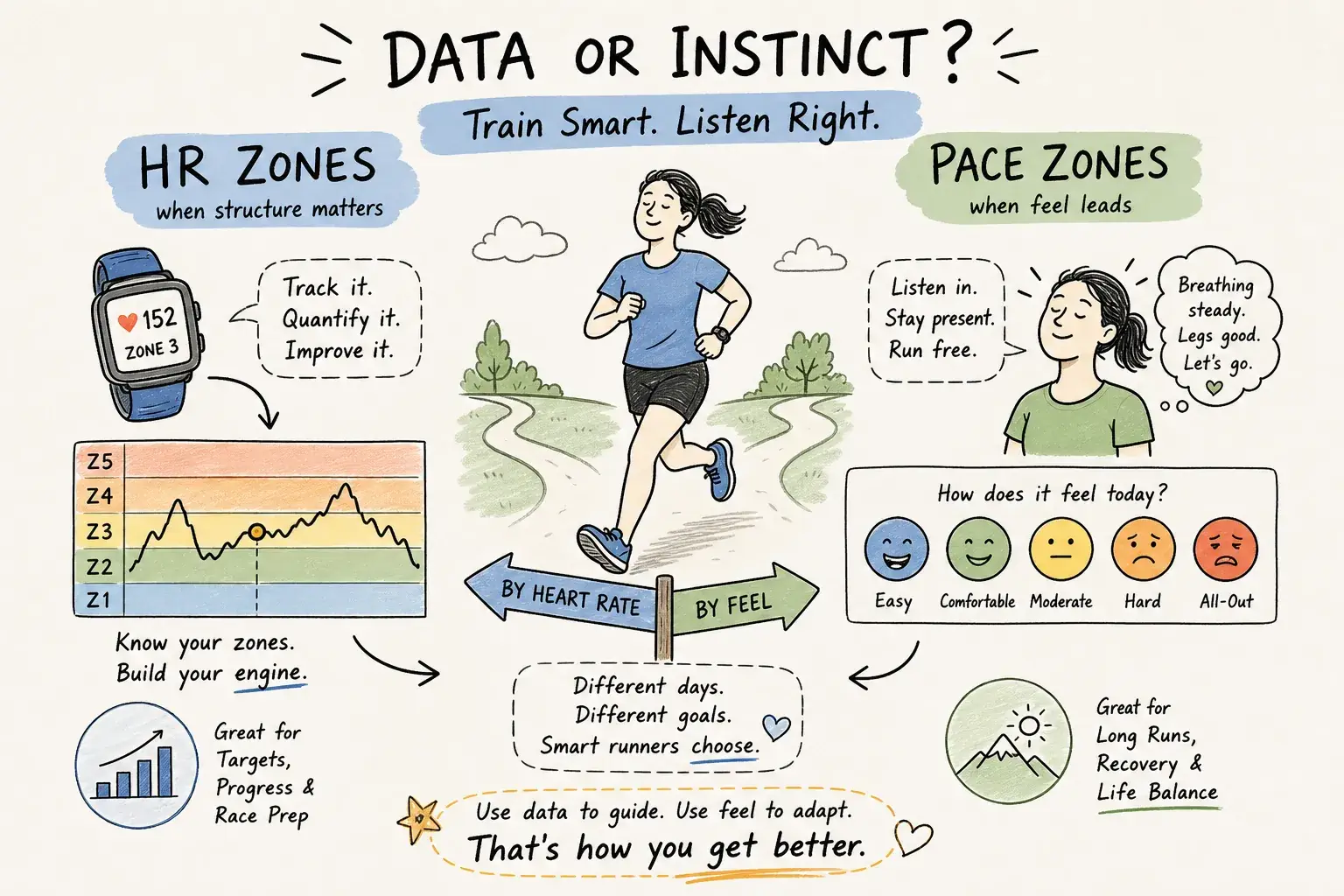
You set out for an easy run. Two kilometres in, your Apple Watch shows 158 bpm, but your legs feel fine and your breathing is relaxed. So which signal is lying? Neither. Both are telling you something real, and the skill is knowing which one to trust on that day, in those conditions.
This is where HR zones become useful: not as a rigid system copied from a website, but as a framework that turns raw numbers into context you can act on.
The problem is that most runners take their heart rate zones from tables built on population averages, not on their own physiology. The standard “220 minus age” formula can be 10 or more beats out for many people. That one error shifts every zone boundary you train against, and it can push what you think is a Zone 2 run into Zone 3 without you realising.
TrakRun reads your Apple Watch and Apple Health data each morning and gives you one daily recommendation, which is built to settle exactly this kind of signal conflict. It helps to understand the framework first, so this guide sets out the zones, how to calculate your own, and when to trust heart rate over pace.
HR zones calculator
Work out your five heart rate zones from your age, or from your own maximum heart rate if you know it. Add your resting heart rate to use the Karvonen method, which the calculation section explains.
HR zones explained: what the five zones actually mean
The percentage breakdown from zone 1 to zone 5
The standard model has five heart rate zones, each a percentage of your maximum heart rate (MHR). These are the bands the Cleveland Clinic uses:
| Zone | % of max HR | How it feels | What it’s for |
|---|---|---|---|
| Zone 1 | 50–60% | Very easy, full conversation | Recovery jogs, warm-ups |
| Zone 2 | 60–70% | Easy, can talk in sentences | Aerobic base, most easy and long runs |
| Zone 3 | 70–80% | Controlled but harder breathing | Steady and tempo running |
| Zone 4 | 80–90% | Hard, talk in short bursts | Threshold intervals of 6–10 minutes |
| Zone 5 | 90–100% | Maximal, no talking | Short repeats of seconds to a couple of minutes |
Not every app uses this model. Oura, for example, splits the same range into six zones, so a “Zone 4” on one device isn’t always a Zone 4 on another. Check which model your watch or app uses before comparing numbers between them.
How long you can hold each zone tells you how to use it. You can hold Zone 2 for an hour-long easy run. Zone 4 suits intervals of six to ten minutes with recovery between them. Zone 5 lasts only tens of seconds to a couple of minutes. Knowing each zone’s ceiling stops you treating them as interchangeable.
Why a zone table you copied from a website isn’t your zone table
The five-zone model is only as accurate as the maximum heart rate behind it. Take a 42-year-old whose formula maximum is 178 bpm (220 minus 42), but whose true maximum is 192. Every boundary in their table is about 14 beats too low.
Their formula Zone 2 tops out at about 125 bpm, which is only 65% of their true maximum. When they think they are pushing into Zone 3, they are still in their real Zone 2. They are undertraining their hard sessions without knowing it. A runner whose true maximum is below the formula has the opposite problem: their “easy” runs are harder than they think.
Generic zone charts are built for an average person, and the average person isn’t in your training plan. Personalisation starts with getting your maximum heart rate right.
How to calculate HR zones that actually fit you
Estimating your max heart rate: two formulas and their limits
The two most common estimates are 220 minus age, and 208 minus 0.7 times age, a formula from Tanaka and colleagues in 2001. For a 40-year-old, both give 180 bpm, which puts Zone 2 at 108 to 126 bpm. For older runners they diverge: at 60, the first gives 160 and the second 166. Both are starting points, not verdicts.
The Cleveland Clinic notes that the most accurate way to find your maximum is a stress test or VO₂ max test. The practical next best is the peak heart rate from a recent race or all-out time trial. Many runners already have that number in Apple Health or Strava without realising what it is worth.
The Karvonen method: using resting heart rate to tighten the calculation
The Karvonen method uses your heart rate reserve (HRR), which is your maximum heart rate minus your resting heart rate. It builds zones from that reserve rather than from the maximum alone. Two runners with the same maximum but different resting heart rates get different zones, which is closer to how their hearts actually work.
The formula: target heart rate equals resting heart rate plus the zone percentage times your heart rate reserve.
- Maximum 190 bpm, resting 48 bpm gives a reserve of 142 beats.
- Zone 2 at 60–70% of reserve is 48 + 85 to 48 + 99, so 133 to 147 bpm.
- The same zone as 60–70% of maximum would be 114 to 133 bpm, a much lower band.
For resting heart rate, use a rolling average of three to seven mornings from Apple Health rather than one reading. A single low or high morning skews every zone.
What throws your zones off on any given day
Your HR zones are not fixed in practice. In heat, hot skin pools blood near the surface, and your heart rate rises to keep up, so the same pace costs more beats. Dehydration reduces plasma volume and does the same. Heavy training, poor sleep and illness all push resting and exercise heart rate up.
Some medicines, beta blockers in particular, cap your maximum heart rate. If you take one, standard zone calculations won’t apply, so ask your doctor what range is safe.
Monday’s zone boundaries may not be the right targets on Thursday. That is not a flaw in zone training. It is why daily context matters.
When to train by heart rate and when pace is the better signal
The case for heart rate on easy and long runs
Heart rate is the more honest signal when conditions add load that pace can’t show. On a humid 28°C morning, a pace that looks easy on paper can put you in Zone 3 before you notice. Running by pace alone that day adds stress you didn’t plan for, and your log won’t show it.
Heart rate also picks up fatigue before your legs do. In a heavy week, the early sign is often a heart rate several beats higher than usual at your normal easy pace, before any soreness appears. Compare it against your own baseline, not a generic figure.
When pace tells you more than heart rate
Pace is the stronger signal on flat, controlled efforts in cool conditions, and in any session built around a specific speed. Track intervals and tempo runs work because you hold a defined pace. Heart rate lags behind short efforts, so it can’t tell you whether a three-minute rep was on target until it is nearly over.
Cardiac drift also makes late-run heart rate misleading. Heart rate climbs steadily while pace holds, so an hour into a long run it no longer reflects your effort as cleanly as it did at the start.
For time trials, fitness benchmarks and structured quality sessions, pace gives the truer picture of what you did. TrakRun’s pace zones are built for exactly those sessions.
How HRV and daily fatigue shift which signal to trust
Heart rate variability reflects how far your nervous system has recovered from recent stress. When HRV is below your normal after hard training or poor sleep, your heart rate tends to run high even at easy paces. That quietly turns a planned Zone 2 run into Zone 3.
Running by pace on a day like that hides the overload. Running by heart rate, with a daily readiness score for context, keeps the session easy, even if the pace looks slower than usual. Slower on a low-readiness day is not a failure. It is the training working.
Simple workouts that target each zone without overcomplicating it
Building aerobic base in zones 1 and 2
Most recreational runners should spend most of their weekly running in Zones 1 and 2. A classic Zone 2 session is 35 to 50 minutes of continuous easy running at 60 to 70% of your maximum.
If your heart rate drifts above the zone, slow down or walk briefly. These runs should feel almost too easy, which is the point. The aerobic base they build supports every hard session you add on top.
Threshold work and steady efforts in zones 3 and 4
A Zone 3 tempo run is typically 20 to 30 minutes at a steady effort, where breathing is controlled but conversation gets clipped. Zone 4 threshold intervals are shorter: three or four repeats of six to ten minutes, with two to three minutes of easy Zone 1 jogging between them.
These sessions raise your lactate threshold, which sets how long you can hold a hard pace in a race. Zone 4 is demanding, so keep it to once or twice a week, and less in high-mileage blocks.
Short, sharp Zone 5 work: less is more
Zone 5 efforts are maximal and brief. A practical session is six to eight repeats of 30 to 60 seconds at close to maximum effort, with full recovery between each. Because heart rate lags on efforts this short, run these by feel or pace rather than waiting for the watch to read Zone 5.
Zone 5 is heavy on your nervous system and needs recovery either side. Most recreational runners need no more than one session a week, and often less in high-volume blocks. More doesn’t speed up adaptation; it speeds up fatigue.
How TrakRun personalises your zones using Apple Watch data
Auto-calibrating zones from your own recent efforts
Rather than a formula built on population averages, TrakRun derives its zones from your own running. They are six pace zones, from recovery to anaerobic, anchored on your predicted 5K.
TrakRun uses a genuine hard effort where you have one. Where you don’t, it models the anchor from your pace and heart rate together, and it tells you which it used. The zones re-derive as your fitness changes, and every run is broken down by the time spent in each.
Heart rate is recorded on every run from your Apple Watch and read alongside pace. That is how you spot the same pace costing more beats than usual.
Letting your readiness score set today’s effort
Each morning TrakRun builds a readiness score from your HRV, resting heart rate, sleep and recent training load, all read from Apple Health. Runs from Strava, Runna or WHOOP count too, because they arrive through Apple Health.
Your Coach turns that into one call: push, adapt or recover. On an adapt day, the session should be easy, so a planned threshold session becomes an easy run. On a recover day, it is rest. Your zones stay the same; what changes is which zone today belongs in.
An example: when the readiness score says no
Take a hypothetical 38-year-old training for a half marathon who has done four quality sessions in four days. On Thursday morning, her HRV is below her normal and her resting heart rate is up. Her readiness is low, and the call is to recover rather than run the Zone 4 intervals she had planned.
She runs an easy 30 minutes in Zone 1 instead. By Saturday her readings are back to normal, and she hits her tempo intervals at target pace with her heart rate under control.
That Thursday decision is where overtraining usually starts. Most runners press on because their legs feel fine and the plan says intervals. The legs are often the last to signal accumulated fatigue. HRV and resting heart rate tend to catch it first.
The zones versus pace debate doesn’t have a single winner
Heart rate wins when conditions are hard, fatigue is real, or you need an honest reading of stress. Pace wins on structured quality sessions and fitness benchmarks. The skill is checking both and knowing which to weight on a given day.
Personalised zones are the foundation. A generic table is a starting point; your own data is the upgrade. The difference shows up in whether your easy runs are actually easy, whether your hard sessions are hard enough, and whether you finish a training block healthy enough to race.
TrakRun is coming soon to the App Store, built for Apple Watch runners who want sleep, HRV and training in one daily call. Recording runs, pace zones and your daily readiness score are free, and TrakRun Pro’s coach reads your data each morning and tells you plainly how hard today should be.
Common questions
- What are the five heart rate zones?
- As a percentage of maximum heart rate: Zone 1 is 50–60% (recovery), Zone 2 is 60–70% (easy aerobic running), Zone 3 is 70–80% (steady and tempo), Zone 4 is 80–90% (threshold) and Zone 5 is 90–100% (short, maximal efforts). The percentages only fit you if the maximum they are built on is yours.
- How do I use the HR zones calculator?
- Enter your age, and your own maximum heart rate if you know it from a recent race; otherwise it is estimated from your age. Add your resting heart rate to switch to the Karvonen method. The calculator shows the bpm range for each of the five zones.
- How do I calculate my HR zones?
- Start from your maximum heart rate. The peak from a recent all-out race or time trial is better than a formula such as 220 minus your age. Multiply it by each zone's percentages, or use the Karvonen method, which builds the zones from your heart rate reserve: maximum minus resting heart rate.
- Is 220 minus age accurate?
- Only as an average. Many runners' true maximum sits 10 or more beats either side of it, which moves every zone boundary by the same amount. The most accurate figure comes from a stress test, and a recent hard race is the practical next best.
- Should I train by heart rate or pace?
- Use heart rate for easy and long runs, especially in heat, humidity or a heavy training week, because it shows what the run is costing you. Use pace for intervals, tempo runs and time trials, where the adaptation comes from holding a specific speed. Check both, and weight whichever fits the session.
- Why is my heart rate high on easy runs?
- The usual reasons are heat, dehydration, poor sleep, accumulated fatigue, illness or cardiac drift late in a long run. It can also be zones built on the wrong maximum. If it is higher than usual at your normal easy pace for several days, that is a signal to ease off rather than push through.
- Does TrakRun calculate heart rate zones?
- TrakRun's zones are pace zones, derived from your own predicted 5K rather than a generic table. It records and reads your heart rate alongside them, and its readiness score and Your Coach tell you each morning whether today should be hard, easy or rest.