Your Coach
A coach that decides each morning, and shows its working.
Your Coach answers the question every runner asks before heading out: should I train today, and how hard? Each morning it reads your recovery, your training load and your recent sessions against your own normal, then makes one call — push, adapt or recover — with the session to do and the readings behind it.
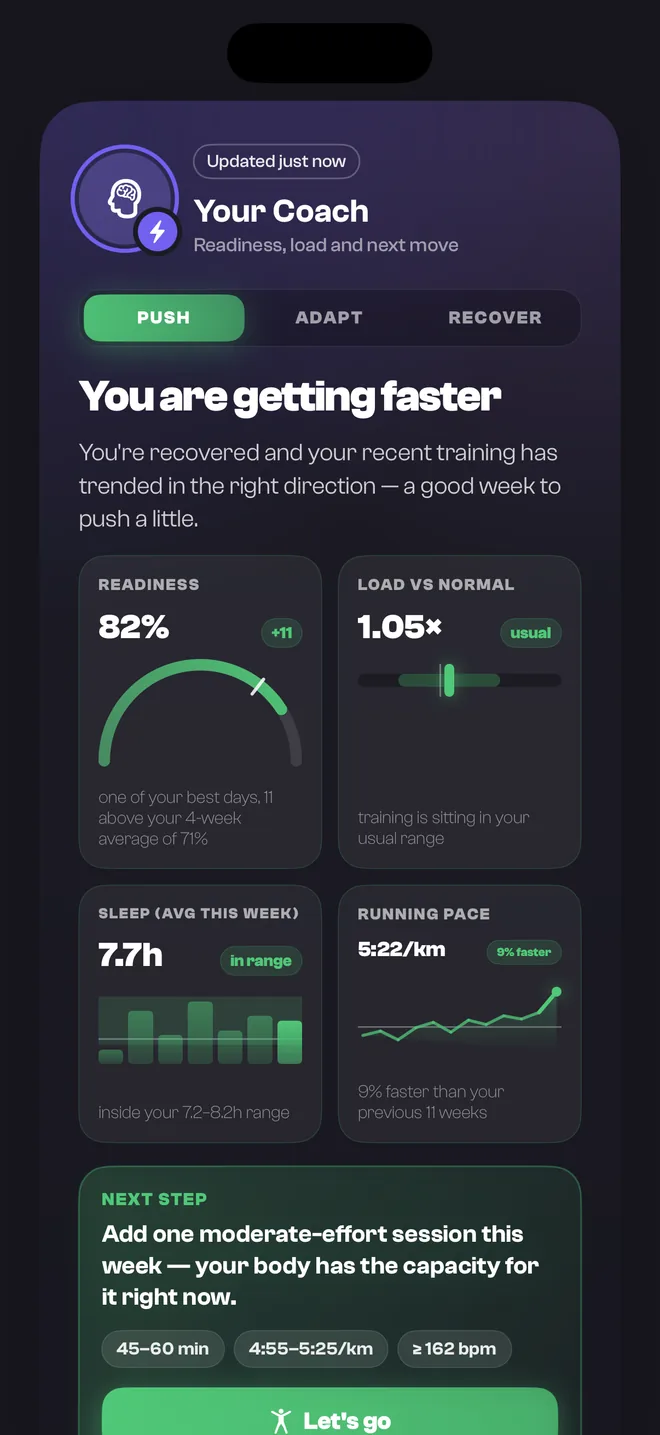
What Your Coach does
Your Coach is a daily coaching card in TrakRun. It answers one question — what is the most important thing to know about training today — and then stops. It is a decision, not a dashboard: hundreds of computed readings go in, and one call comes out.
That call is always about today, as of your own local morning. It is not a weekly verdict you are held to on Thursday, and it is not a plan. When something that matters changes — a session logged, a night slept, a check-in answered, an injury recorded — the card is rebuilt from the new picture.
Push, adapt or recover
The card leads with a stance, drawn as a position on a three-way scale. The stance follows how hard today’s session should be, so you can read it at a glance:
- Push — you are fit for a steady or a hard session. Behind it sits one of three reads: ready to train, building fitness, or maintaining.
- Adapt — fit to train, but today should be easy. Something about your recent training, recovery or schedule argues for changing the session rather than cancelling it.
- Recover — today is for rest. Your recovery readings, your fatigue or an injury you have logged say to reduce training stress.
Under the stance, a short headline names what today is about, and a sentence or two of summary says which readings led there. Every figure lives in a tile rather than in the prose, so no number you read was guessed at by a language model.
How it decides
The call is made by rules applied in a fixed order of priority, and the first one that applies wins. Safety always comes before fitness:
- Recover if you have logged an injury, your fatigue reads high, or your readiness is very low. No amount of good training data overrides this.
- Adapt if your recovery is asking for an easier day, your fatigue or injury risk is elevated, or you did something strenuous in the last day.
- Adapt if your training has a pattern a coach would change — most often, easy running quietly disappearing until every run is moderate.
- Building fitness if a sport is measurably improving and nothing says it is costing you.
- Ready to train if your recovery reads normal and nothing above applies.
- Maintaining otherwise — stable, with no change needed.
A below-average morning is not enough on its own
Your readiness bands are set from your own score history, so a below-average band holds a fixed share of your days whatever you do. Treating it as a reason to ease off would mean “take it easy” on a large share of mornings however well you were training. So a merely low reading needs something to agree with it: your score clearly down on your four-week average, another recovery reading pointing the same way, or training load that is climbing. A very low reading still stands on its own.
What you have done recently
Recovery is only half of whether today can be hard. The card also reads your schedule:
- Three or more days since you last trained caps today at easy. You are not mid-block, so today eases you back in — and the card says that is the reason, rather than implying you have been overdoing it.
- The day after a session, if you normally leave a rest day between sessions, is capped at easy too.
- A week already well above your recent weeks leaves no room to add, even on a good recovery morning.
- A session already logged today settles it: the card says the work is done rather than telling you to go out again, or to take a day off you have already trained through.
A walk to the shops does not count as a session. If you walk every day, that alone will never read as back-to-back training or a reason to rest.
The readings behind the call
Beneath the summary sit up to four tiles, each against your own normal rather than a population table:
- Readiness— today’s score against your four-week average.
- Load vs normal — this week’s training load against the four weeks before it.
- Sleep — your seven-night average against the range you do best on.
- Pace — your main sport over the last fortnight, against the ten weeks before it.
That split between the last fortnight and the stretch before it is deliberate. Comparing two weeks with a baseline that already contains those two weeks averages away part of the change you are trying to see. And a pace comparison is never treated as a fitness claim by itself: a fortnight of harder running is faster without you being fitter, so the card only calls you quicker when your pace per heartbeat agrees.
It reads every sport you train — running, cycling, swimming and walking — each on its own terms. A hard week on the bike is not a hard week of running, because only running carries the repeated impact that makes a sudden jump in distance risky.
The next step
Every card ends with exactly one action: specific, doable today, and in the sport you actually train. Not a menu, and never “monitor how you feel”. It commits to whether you train, not only how hard — “head out for an easy run” rather than “keep today’s run easy”.
Beside it are targets — duration, pace and a heart-rate ceiling — drawn from your own sessions at that effort. Easy means heart-rate zones one and two, steady means zone three, and hard means four and five. If you have never trained at the effort the card asks for, it gives you the nearest easier effort you have trained at, and says so. Tap Let’s go and the recording screen opens with that session set up. On a rest day there is nothing to start, so there are no targets.
How sure it is
Every card carries a confidence level — high, medium or low — and the signals behind it, each marked as backing the call or not. Confidence drops with a short history, a thin last fortnight, recovery and training readings that disagree, or sports trending in opposite directions.
Confidence changes how the card speaks, not whether it speaks. A high-confidence card says it plainly; a medium one hedges; a low one leads with whatever is firmly supported, even if that is a smaller point. A signal you do not have is simply left out — the card never tells you it is short of data.
Where the AI fits
The decision is TrakRun’s: the stance, how hard today should be, the targets and the confidence level are all calculated from your data before a word is written. A language model then writes the headline, the summary, the action and the reason for the confidence level, working from a brief of conclusions rather than your raw workouts. It cannot do the arithmetic, so it cannot get the arithmetic wrong.
Its draft is then checked against the decision. A sentence promising a harder session than the targets beneath it, or calling a trend improving that is declining, is sent back for a rewrite — and a card that still misleads is withheld rather than shown.
What it will not do
- Diagnose. It never names a medical condition or implies an injury you have not logged. If you log one, it coaches around it.
- Overreact. One bad night or one slow run is noise. Agreement across signals is what moves the call.
- Guilt you. No streaks, no red alerts. A rest day is a call made in your favour, not a failure.
- Overrule you. It shows its readings so you can look at them, decide something is weighted wrongly, and go and run anyway.
Getting Your Coach
Your Coach is part of TrakRun Pro, alongside Run Analysis and training-load analysis. It builds on the free readiness score and pace zones. Everything it reads arrives through Apple Health, so runs recorded in other apps count, and an Apple Watch worn overnight supplies the recovery readings.
Recording is free, and the history you build on the free tier is what the coach reads from the day you upgrade — so it starts with your training, not a blank page.
Common questions
- Is Your Coach an AI running coach?
- Partly, and the split is deliberate. The decision — whether today is push, adapt or recover, how hard the session should be, your targets and how confident the card is — is calculated by TrakRun from your data with fixed rules. A language model then writes the headline, the summary and the action around that decision. It never sees your raw workouts and cannot change the call, so the wording can vary but what it tells you to do cannot.
- Is Your Coach a training plan?
- No. TrakRun holds no plan and never assumes one, so the card never tells you to do "your planned session". It reads what you have actually been doing and recommends the session that fits today. If you follow a plan from a coach or another app, Your Coach is a daily check on whether today suits the session the plan has in it.
- Why is it telling me to take it easy when I feel fine?
- Usually for one of three reasons: it has been three or more days since you last trained, you normally rest between sessions and trained yesterday, or this week is already well above what your recent weeks carried. None of those says anything is wrong with you — the headline and summary say which one it is. It is a suggestion, not a rule: you know things the data doesn't.
- Do I need an Apple Watch for Your Coach?
- No, but it helps. Without overnight readings from a watch there is no readiness, heart rate variability or resting heart rate to read, so the card coaches on your training and sleep alone and is less certain of itself. A missing sensor is never read as a bad sign — it just means fewer signals behind the call.
- How much history does Your Coach need?
- It works from your first logged session, and gets sharper with time. Comparisons against your usual pace need about four weeks of history, and the card is more confident once you have eight or more sessions and three weeks of training load behind it. Runs already in Apple Health count, so most people start with months of history rather than none.
- Is Your Coach free?
- Your Coach is part of TrakRun Pro, a monthly or yearly App Store subscription. On the free tier you see a preview of the card. Recording runs, history, interval sessions and mood and injury logging are free, and all of it feeds the coach from the day you upgrade.