Pace zones
Pace zones that come from your running, not a table.
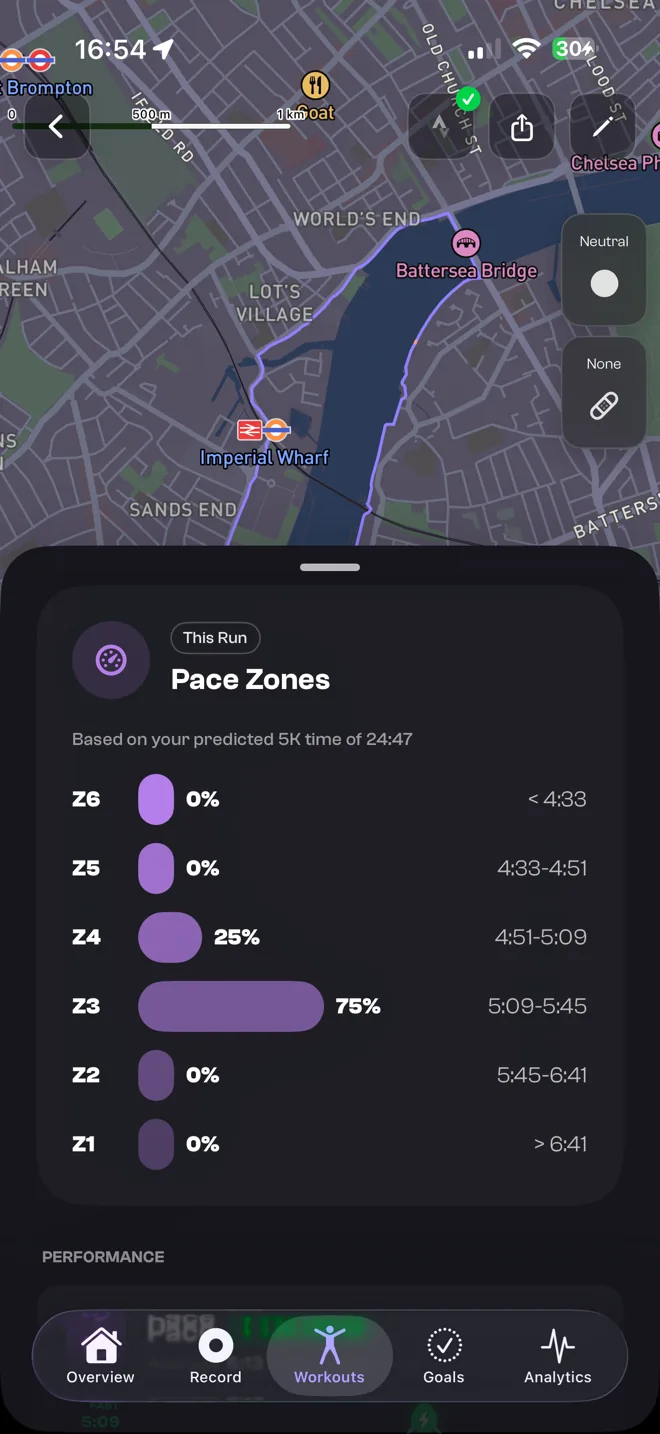
Pace zones turn a pile of splits into something you can act on: how much of your running is genuinely easy, and how much of it only feels like it. The zones are only useful if they are yours — anchored on what you can currently run, not on a table you found.
Why zones need an anchor
A pace zone is a band, and a band needs something to be a band around. Age-based tables can’t supply that: two runners the same age can be twenty minutes apart over a half-marathon, and a zone chart that puts them in the same rows is describing neither of them.
The usual anchor is a recent 5K. It is long enough that it is mostly aerobic, short enough that it is honest, and it moves when your fitness moves. Every other zone is then expressed as a percentage of that pace — which is why a good set of zones re-derives itself as you get fitter rather than sitting still for a season.
The six zones, and what each is for
TrakRun uses six, running from slowest to fastest. The point of the slow end is that it is where most of your week belongs.
- Recovery — slower than easy, and meant to be. The day after something hard, where the job is circulation rather than fitness.
- Easy — conversational, and the backbone of the week. This is the zone most runners spend too little time in.
- Steady — comfortably firm. Useful, and the easiest zone to end up in by accident when an easy run drifts.
- Threshold — the pace you could hold for about an hour under pressure. Where a lot of the aerobic return lives.
- VO₂ max — hard intervals, minutes at a time, with real recovery between them.
- Anaerobic — short, fast repetitions for speed and running form rather than for endurance.
The 80/20 problem
The best-known guidance in distance running is that roughly 80% of your time should be easy and 20% hard. It is easy to agree with and hard to do. Left unmeasured, easy runs creep up into steady, hard sessions lose their edge because you arrive tired, and the whole week collapses into one moderate pace that develops very little.
This is exactly what a zone breakdown is for. It is not a target to hit on any single run — an interval session is supposed to be mostly hard — but across a few weeks it tells you whether the easy days are doing their job. If most of your time sits in steady rather than easy, that is usually the finding, and it is usually the fix.
How TrakRun builds your zones
TrakRun derives the anchor from your own running rather than asking you to enter a race time. It will use a genuine hard effort where you have one, model it from your pace and heart rate together where you don’t, and fall back to your training baseline before it resorts to a population default — and it tells you which of those it used, so you know how personal the zones currently are.
Every run is then broken down by the share of moving time spent in each of the six zones, so an individual session can be checked against what it was supposed to be. A recovery run that spent a third of its time in steady wasn’t a recovery run.
Pace zones are free, and they read every run in Apple Health — including sessions recorded elsewhere. They sit alongside training load, which answers the related question of how much you are doing rather than how hard.
They are also what a zone target on a structured interval session should be set from, so the repeats you run at “threshold” are at yours rather than at a table’s.
For how zones, heart rate drift and GPS play out over 26.2 miles, see pacing and recovering for the London Marathon.
If you train by heart rate instead, or want to know when it beats pace, see HR zones versus pace zones.
Common questions
- How do I work out my running pace zones?
- Anchor them on a recent hard effort rather than on your age or a generic table. A 5K is the usual anchor because it is long enough to be aerobic and short enough that most runners have run one honestly. Every zone is then a percentage band around that pace. TrakRun does this automatically from your own runs, and re-derives it as your fitness changes.
- Are pace zones better than heart rate zones?
- They answer different questions. Pace is what you did; heart rate is what it cost. Pace is immediate and unaffected by caffeine, heat or a bad night, which makes it the better target mid-run. Heart rate is the better check afterwards — the same pace at a higher heart rate than usual is the signal worth having. TrakRun reads both.
- How much of my running should be easy?
- The common guidance is roughly 80% easy and 20% hard, measured in time rather than sessions. Most runners who check find they are nearer 60/40, because easy runs drift up in pace when nothing is measuring them. That drift is the single most common reason a training block stops working.
- Do pace zones work on hills or a treadmill?
- Less well, and it is worth knowing why. Pace is a poor proxy for effort when the gradient changes, so a hilly run will look easier than it was and a descent harder. Read those runs on heart rate and how they felt, and save pace zones for flatter ground and the treadmill.