Indoor runs
A treadmill run, recorded as a treadmill run.
Most running apps treat an indoor run as an outdoor run that went wrong — a flat line where the route should be, an elevation chart of nothing, a GPS trace that wandered around the gym. TrakRun records it as what it is instead.
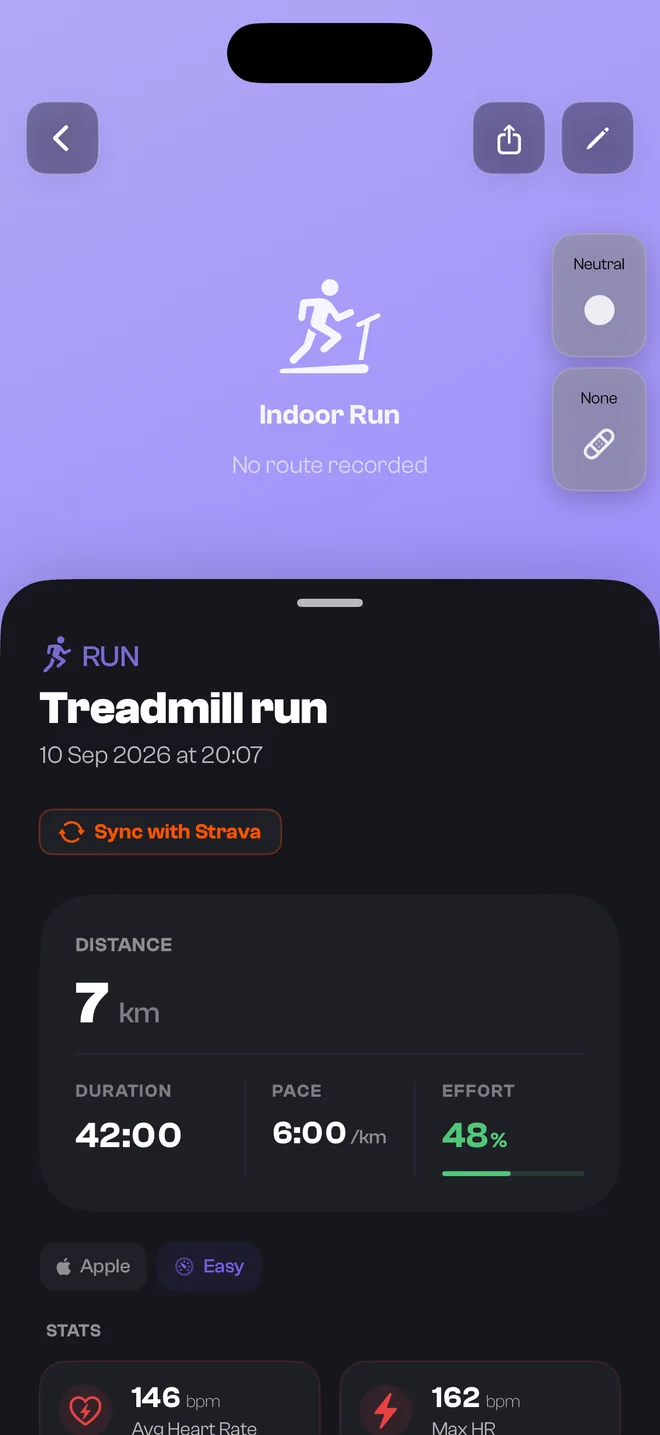
Indoor is a mode, not a failure
When you tell TrakRun the run is indoors, three things change. Location tracking is skipped entirely rather than left on to produce a scribble. Distance comes from motion instead of GPS. And the run is not decorated afterwards with a map and an elevation profile it never had.
That last one sounds cosmetic and is not. A run summary that shows you 40 m of climb you did not do, on a route you did not take, is a record you cannot trust later — and the whole value of a training history is that you can look back at it and believe what it says.
What you still get indoors
Everything that does not depend on knowing where you are:
- Time, distance and pace, live and afterwards, with your splits.
- Heart rate from the wrist — or from a Bluetooth chest strap, which is worth pairing indoors specifically.
- Spoken cues for each split and, if you have set a target pace, whether you are fast, on pace or slow.
- Live Activity on the Lock Screen and in the Dynamic Island, so the phone propped on the console is still telling you something.
About the distance
Worth saying plainly, because most apps let you find it out on your own: a motion-derived distance and the number on the treadmill’s console will not usually agree exactly.
They are measuring different things. The console counts how far the belt travelled, which is precise about the machine and says nothing about your stride. Motion-derived distance estimates what you did, which is closer to the question you are asking but is still an estimate. Neither is the truth, a few percent between them is ordinary, and the useful discipline is to compare like with like — treadmill against treadmill, road against road — rather than to decide which display to believe.
It counts like any other run
Nothing about your training is downgraded for having happened indoors. A treadmill session feeds your training load, moves the acute side of the ratio, and shows up in the pattern TrakRun watches — how fast your volume is ramping, whether your hard days have anything easy between them.
It feeds tomorrow’s readiness score too, and it counts towards your goals. Which is the right way round: your body does not know the difference between a hard 10 km outdoors and a hard 10 km on a belt, so your training history should not pretend it does.
Runs you recorded on the machine’s own app
If a gym treadmill or another app wrote the session to Apple Health, TrakRun reads it from there and counts it like anything else, with its original source kept. You do not have to have opened TrakRun for the run to be part of your training picture.
Recording indoor runs is free, like the rest of the run tracking — unlimited, with no adverts.
Common questions
- Does TrakRun work on a treadmill?
- Yes. Indoor runs are their own mode rather than an outdoor run with a broken GPS trace. Location tracking is skipped, distance comes from motion, and the run is not given a map and an elevation profile it never had.
- Why does my treadmill's distance differ from the app's?
- Because they are measuring different things. The treadmill counts belt revolutions, which is exact for the belt but not necessarily for you; a motion-derived distance is an estimate of your own stride. Neither is authoritative, and a gap of a few percent between them is normal — what matters for training is that you compare like with like over time.
- Do indoor runs count towards my training load?
- Yes. A treadmill run is a run: it feeds your training load, your readiness score and your goals exactly as an outdoor run does. The only difference is what was recorded, not what it counts for.
- Can I use a chest strap for indoor runs?
- Yes, and indoors is where it earns its keep. TrakRun connects to standard Bluetooth heart rate monitors such as a Garmin HRM or Polar chest strap and uses the strap's reading instead of the wrist's, reconnecting on its own if the signal drops mid-session.